Start with what your baby actually needs
Most babies do well with just three basics: a mild cleanser, a plain moisturizer for dry spots, and a diaper barrier cream. Babies with textured hair may also benefit from a gentle conditioner or leave-in. Everything else is optional.
Every baby’s skin is different. A product that suits one baby may irritate another. Your baby’s skin, climate and family history should shape your choices more than any marketing claim.
Decoding common label terms
Fragrance-free vs. unscented
“Fragrance-free” usually means no fragrance has been added. “Unscented” can mean a masking fragrance was added to cover the smell of other ingredients. Fragrance is one of the most common causes of skin allergies.
Hypoallergenic
There’s no required standard for this term. It doesn’t guarantee a product won’t cause a reaction.
Natural or organic
Natural ingredients can still irritate skin — essential oils and plant extracts are common culprits. Natural doesn’t automatically mean gentler.
Tear-free
Designed to sting less, but you should still keep product out of your baby’s eyes.
What to skip for babies
- Strong fragrances and perfumes
- Essential oils, especially for young babies
- Antibacterial soaps for everyday use
- Baby powder and talc, which can be inhaled
- Adult products such as exfoliants, retinoids or acne treatments
- Bubble baths, which can irritate skin
How to try a new product
- Introduce one new product at a time.
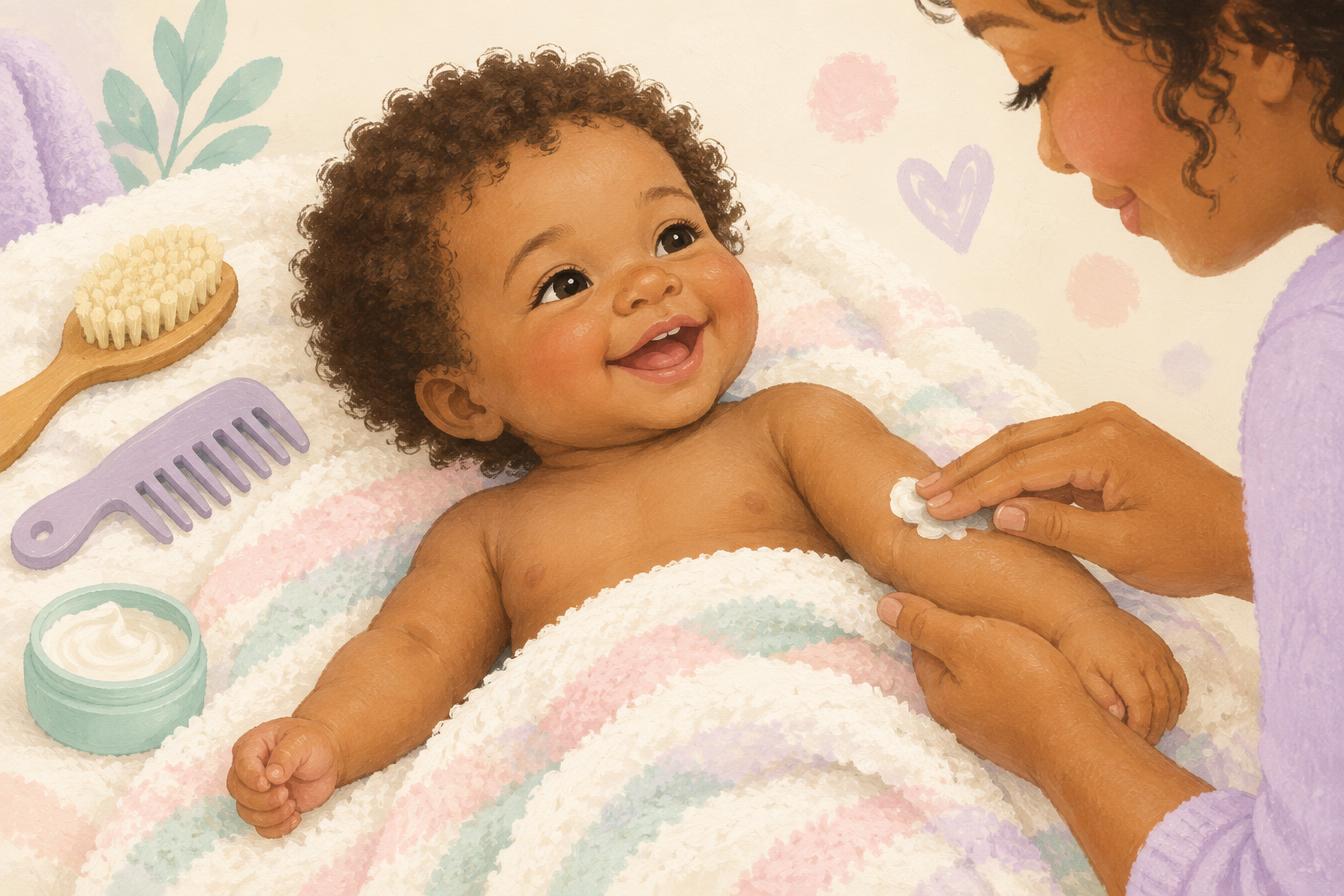
- Apply a small amount to a small patch of skin, such as the inner arm.
- Wait 24 to 48 hours and watch for redness, bumps, darkening or itching.
- If there’s no reaction, use it as normal.
- If there is a reaction, stop using it and note the ingredients.
Products for babies with textured hair and melanin-rich skin
Melanin-rich skin can show dryness as ashiness, and irritation as dark spots that linger. Richer creams and ointments may suit dry skin better than thin lotions. For curly and coily hair, a mild cleanser and conditioner help with detangling; heavy greases and oils left on the scalp can build up.
Building a small product kit
A small, consistent kit makes daily care simpler and makes it easier to notice if something doesn’t suit your baby. Here’s one way to think about it:
Everyday
- Mild, fragrance-free cleanser
- Zinc oxide or petroleum-based barrier cream
As needed
- Plain, fragrance-free cream or ointment for dry skin
- Gentle conditioner for longer or curly hair
Later
- Broad-spectrum SPF 30+ sunscreen from around 6 months
- Infant toothbrush and a rice-grain smear of fluoride toothpaste
Not needed
- Powders
- Perfumes and colognes
- Adult skin care or hair styling products
At every age
Every child is different — use these as a starting point, not a rulebook.
Newborn
Water and a mild, fragrance-free cleanser used sparingly. Barrier cream for diapers.
3–12 months
Add a plain moisturizer if skin is dry. Consider a gentle conditioner for longer hair.
1–2 years
Your toddler still needs only a few simple products. Continue to avoid adult cosmetics.
Common mistakes to avoid
- Trusting front-of-bottle claims instead of reading the ingredients.
- Switching products often.
- Assuming a product that suited an older sibling will suit a new baby.
- Layering many products on the skin at once.
Helpful parent tips
- Photograph the ingredient list of any product your baby reacts to.
- Choose pumps or tubes over open jars to keep products clean.
- Ask your pediatrician about products if your baby has eczema, allergies or very sensitive skin.
Questions parents ask
Do babies need special baby products?
Not necessarily. Mild, fragrance-free products designed for sensitive skin are generally suitable. Avoid adult cosmetics and treatments.
Is ‘natural’ better for babies?
Not always. Some natural ingredients can irritate skin or trigger allergies.
How many products does my baby need?
Usually three or fewer: a cleanser, a moisturizer and a barrier cream.