Why textured hair tangles
Curls and coils naturally wrap around each other, and shed hairs get caught in the curl instead of falling away. Add dryness, friction from pillows or hats, and a few days of wear, and tangles build up quickly. Dry hair is also more fragile, so pulling a comb through it snaps strands.
Detangle damp, never dry
Dermatologists recommend combing textured or tightly curled hair only while it is damp, with a wide-tooth comb, and say the best time for thick, curly hair is while conditioner is still in. Slip — the slippery feel conditioner gives — is what helps strands slide apart instead of snapping.
Tools that help
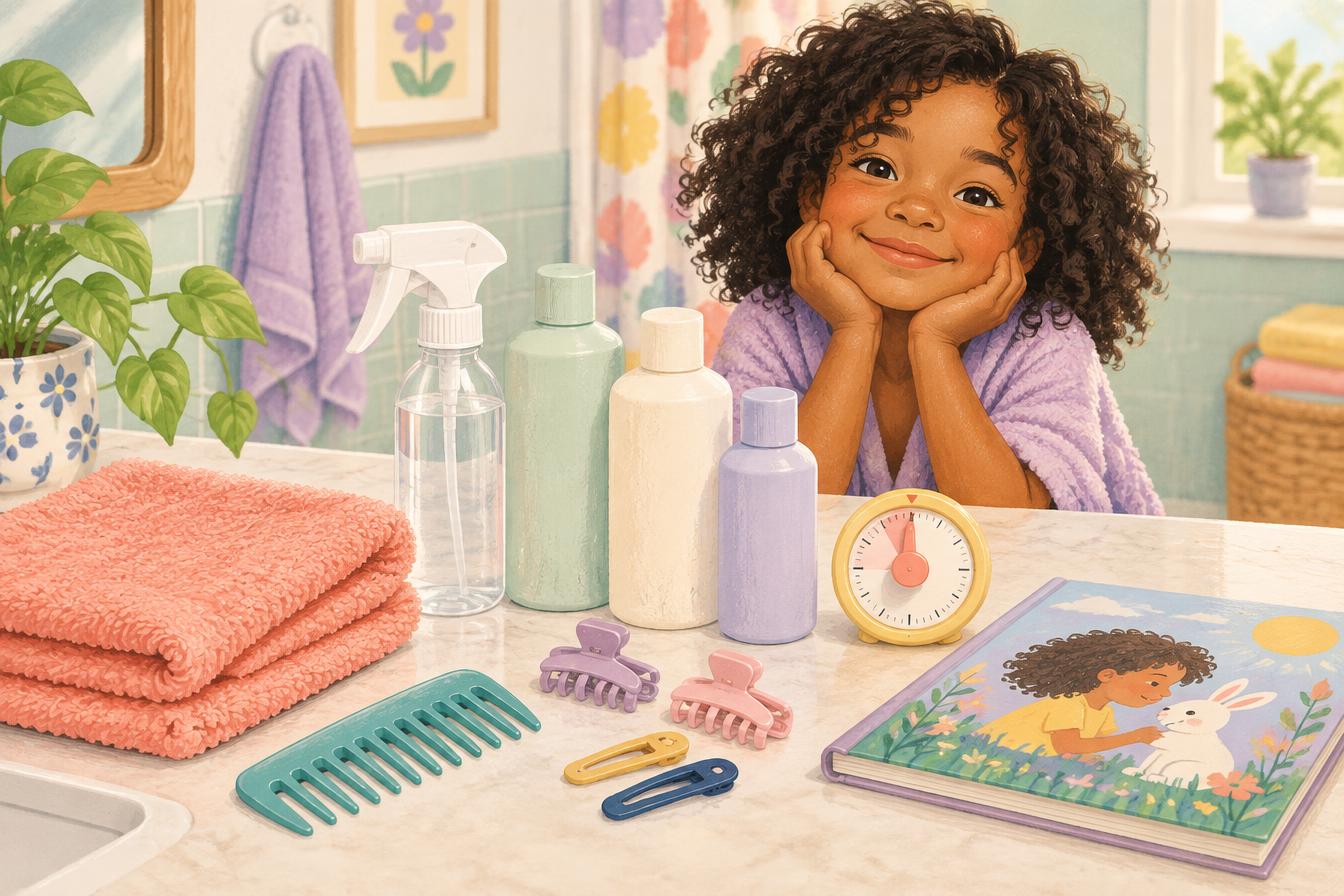
- Your fingers: the gentlest tool, and the best for finding knots.
- A wide-tooth comb for working through each section after finger-detangling.
- A flexible detangling brush can work on some curl patterns, used gently on well-conditioned hair.
- Four to eight clips or soft ties to keep sections separate.
- A spray bottle of water to re-dampen sections that dry out.
Step by step
- Dampen the hair and apply a generous amount of conditioner or detangler.
- Divide the hair into sections — four for short hair, six to eight for long or thick hair — and clip them away.
- Take one section. Gently pull it apart with your fingers first, removing shed hairs.
- Hold the section firmly near the middle so any pulling happens against your hand, not your child’s scalp.
- Comb the last inch or two of the ends first. Once they’re smooth, move a little higher, and keep working up toward the scalp.
- Twist, braid or clip the finished section so it doesn’t re-tangle.
- Repeat for each section, re-dampening as needed.
Tip: Holding the hair above where you’re combing is the single biggest comfort change most families can make.
Stubborn knots and matting
Add more conditioner and a little water, then use your fingers to tease the knot apart from the outside in. Work slowly, taking breaks. Avoid cutting knots unless they are truly impossible, and don’t try to rip them through with a comb. For heavily matted hair after a long-worn style, spread the work over two sessions, or ask a stylist experienced with children’s textured hair for help.
Reducing discomfort
- Offer a “pause” signal and honor it every time.
- Narrate what you’re doing: “Two more sections, then snack.”
- Keep sessions short and plan styles that last several days so detangling isn’t daily.
- Protect hair at night to cut down on new tangles.
At every age
Every child is different — use these as a starting point, not a rulebook.
Babies
Fingers or a soft brush only. Tangles are rare on short baby hair.
Toddlers
Keep sessions under 10–15 minutes. Detangle in the bath while they play.
Preschoolers & school age
Let them finger-detangle a front section while you work on the back.
Preteens
Teach the ends-first method so they can detangle independently and gently.
Common mistakes to avoid
- Combing from the scalp down through the whole length at once.
- Detangling dry hair or hair with no conditioner.
- Using fine-tooth combs on curly or coily hair.
- Rushing because you’re short on time.
- Detangling the whole head as one piece instead of in sections.
Tips for curly, coily and textured hair
- Tighter coils usually do best with more finger-detangling and less combing.
- Detangling once or twice a week, on wash day, is enough for many children.
- Stretch hair in twists or braids after detangling to reduce new knots.
Questions parents ask
How often should I detangle?
Most children with curly or coily hair only need a full detangle on wash day or when changing styles. Daily combing through isn’t necessary and can increase breakage.
Is shedding while detangling normal?
Yes. Shed hairs get trapped in curls, so you’ll see a small ball of hair after detangling. Talk to your pediatrician if you notice patches or a sudden large change.
Brush or comb?
A wide-tooth comb and fingers are the safest starting point. Some families like flexible detangling brushes; use them gently, on damp, conditioned hair only.